Why HTML?
Use HTML artifacts when seeing or trying an idea is clearer than reading about it.
Agents often answer with prose, and sometimes that is the right format. HTML can be easier to understand when you need to compare designs, try a flow, inspect a system, or show how something works.
The medium earns its place when it removes translation work.
Confirm the owner, resolve blockers, validate the build, then release.
- Resolve blocking checks
- Confirm ownership
- Run validation
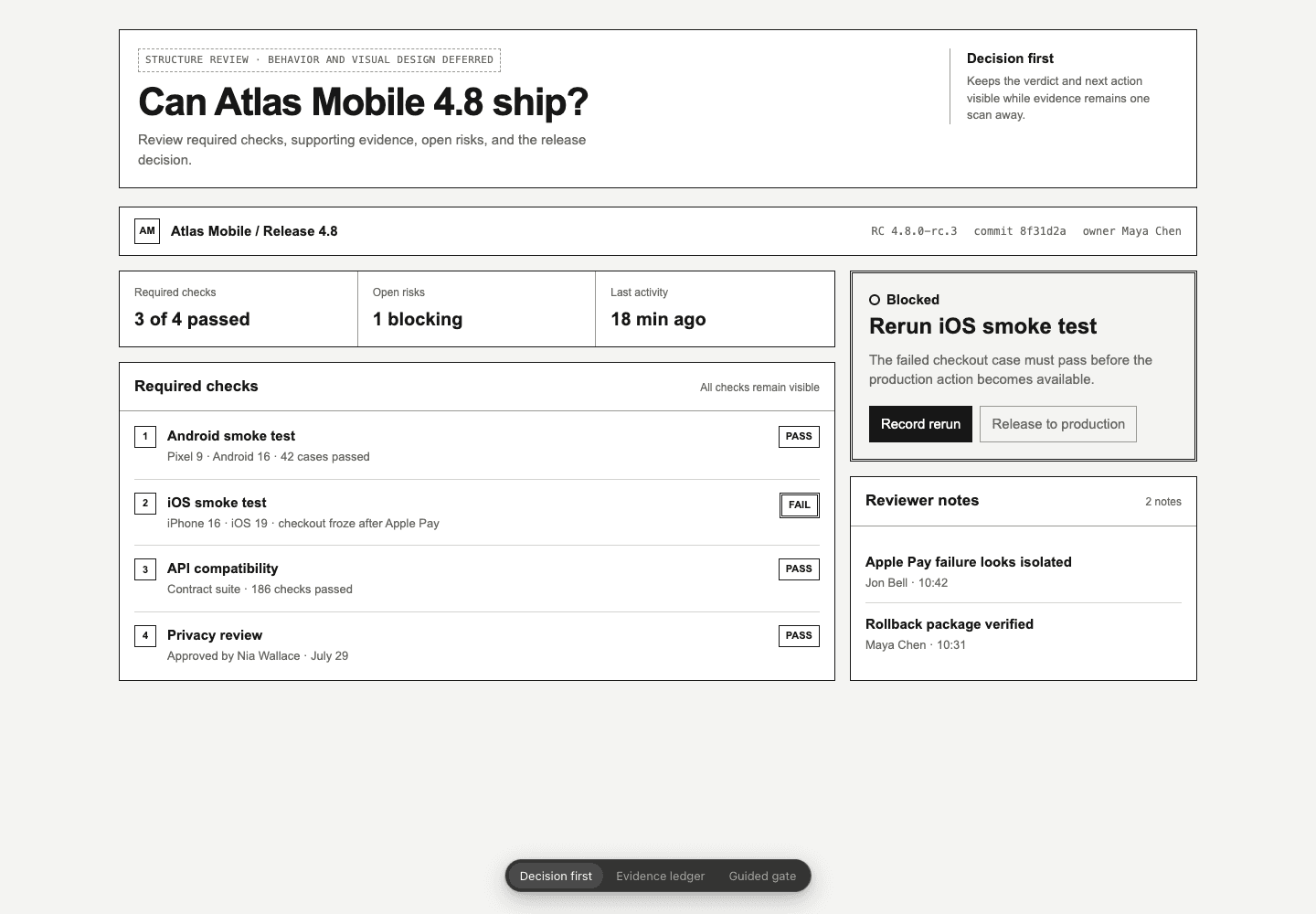 HTML · spatial evidence
Both artifacts can be correct. Use the HTML version only when seeing hierarchy, width, state, or interaction changes the review.
What HTML adds
HTML can put explanation, layout, state, and interaction in one file. You can open it in a browser, test it at real sizes, click through it, annotate it, and share it with technical or non-technical collaborators.
That makes HTML useful for wireframes, mockups, prototypes, diagrams, visual explainers, reports, presentations, and small purpose-built tools.
Keep Markdown when it is enough
Markdown is usually simpler for notes, short plans, and linear explanations. Use HTML when seeing or trying the idea adds something useful.
Wireframe, mockup, or prototype?See the practical difference between the common levels of fidelity.